Sundials of the Edo Period
The earliest evidence of humans dividing the day into hours and measuring the hourly divisions of daylight dates from the Babylonian Era around 2500 BCE. It consisted of a pole in the ground and measuring the position of the shadow. Sundials spread to the Indus Civilisation (India) and the Huang Civilisation (China) along the Spice and Silk Roads. However, it wasn’t until the 11th Century that sundials reached Japan during the Manju Period.
Hidokei often served as reference instruments for Wadokei setting. Many portable sundials were engraved for specific latitudes or regions, most commonly Edo (Tokyo). Deviation from intended latitude affects accuracy, making these instruments highly place specific. Fine examples show exceptional control of line depth, symmetry, and surface finishing, reflecting the broader Edo culture of precision craftsmanship.
Types of Hidokei
Gnomon Sundials – Hashira-dokei-shiki hidokei – Sundials that employ a vertical gnomon pillar (hashira). They can be among the earliest portable Japanese forms, and they are optimised for temporal hours. Intimately connected with pillar clocks – hashira-dokei.
Folding Sundials – Oritatami hidokei – Hinged sundials designed for travel and storage. Typically, of brass construction with folding gnomon and engraved plates. Used by merchants and travellers.
Horizontal Plate Sundials – Heimen hidokei – Flat engraved plates with raised or removable gnomons. Used both domestically and portably.
“Four Seasons Plate” – Shiki-ban – A simple version of Horizontal Plate Sundial was a flat paper version where strips of the paper could be turned up to create gnomons. They were often printed to provide temporal hours. Further, due to variations in day length across regions, these were often included with local guide maps for specific areas.
Magnetic Compass Sundials – Hōi jishin-tsuki hidokei – Sundials incorporating a magnetic compass to ensure correct alignment. Combines geomagnetism, astronomy, and timekeeping.
Variable-Hour Sundials – Futei-jihō hidokei – Designed for Japan’s unequal temporal hour system with hour lengths that vary with the seasons. Often engraved with monthly or sliding scales.
Examples of Hidokei in Author’s Collection
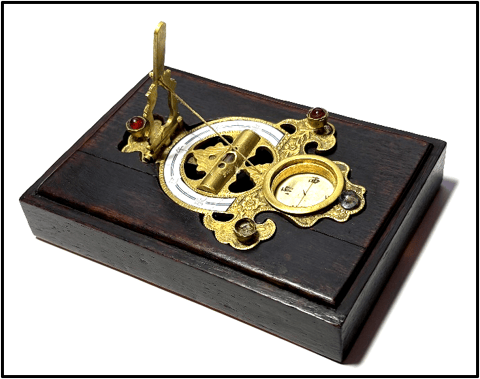
Hoi jishin – tsuka hidokei
Horizontal Compass Sundial
Sundial incorporating a magnetic compass to ensure correct alignment. With two jewel topped level adjusting screws and spirit level.
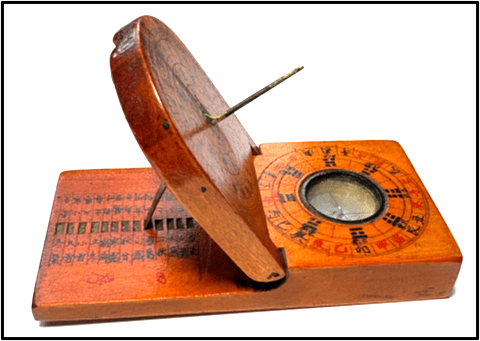
Hashira Hoi jishin tsuki hidokei
Vertical Gnomon Compass Sundial
Hinged sundials designed for travel and storage. Wood construction with brass folding gnomon. Used by merchants and travellers.
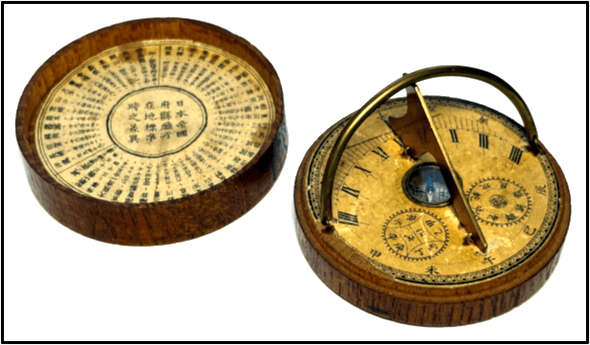
Oritatami Hoi jishin tsuki hidokei
Folding Compass Sundial
Circular wooden “pill box” style case with solid brass folding plate gnomon, stabilised with fold-flat semi-circular brass wire. Carried in kimono sleeve or small inro bag
.
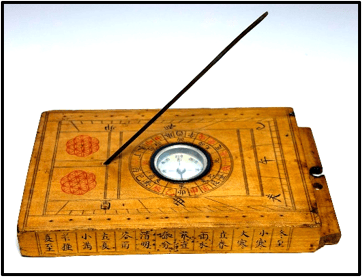
Heimen hidokei
Horizontal Plate Removable Gnomon Sundial
Simple version of Horizontal Plate Sundial with removable brass needle gnomon. They were often printed to provide temporal hours. Laid on a flat surface with the gnomon facing to the north as determined by the integral compass.
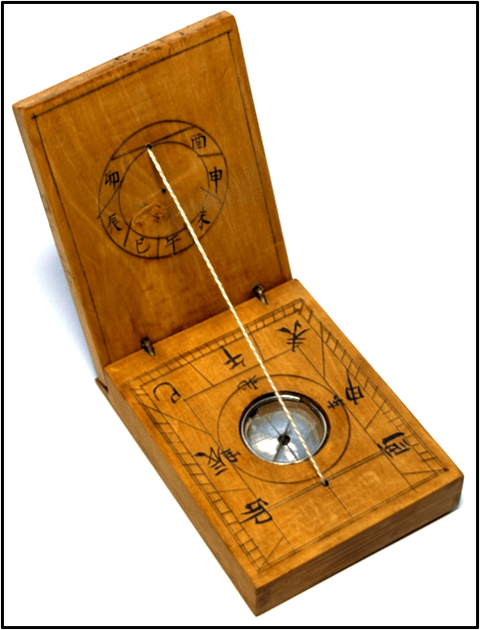
Hōi jishin-tsuki hidokei
Folding Compass Chord Gnomon Sundial
Another simple version of Horizontal Plate Sundial but with hinged lid. Length of chord supporting lid set by Latitude of use.
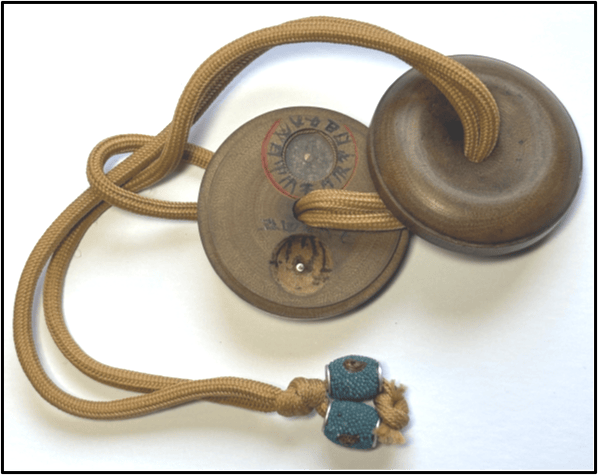
Hoi jishin tsuki hideoki sagemono
Hanging Netsuke Sundial
An amateur home-made timepiece following the principles of more sophisticated Sundials. Fruit wood turned case with simple compass and simple sumi ink markings.

