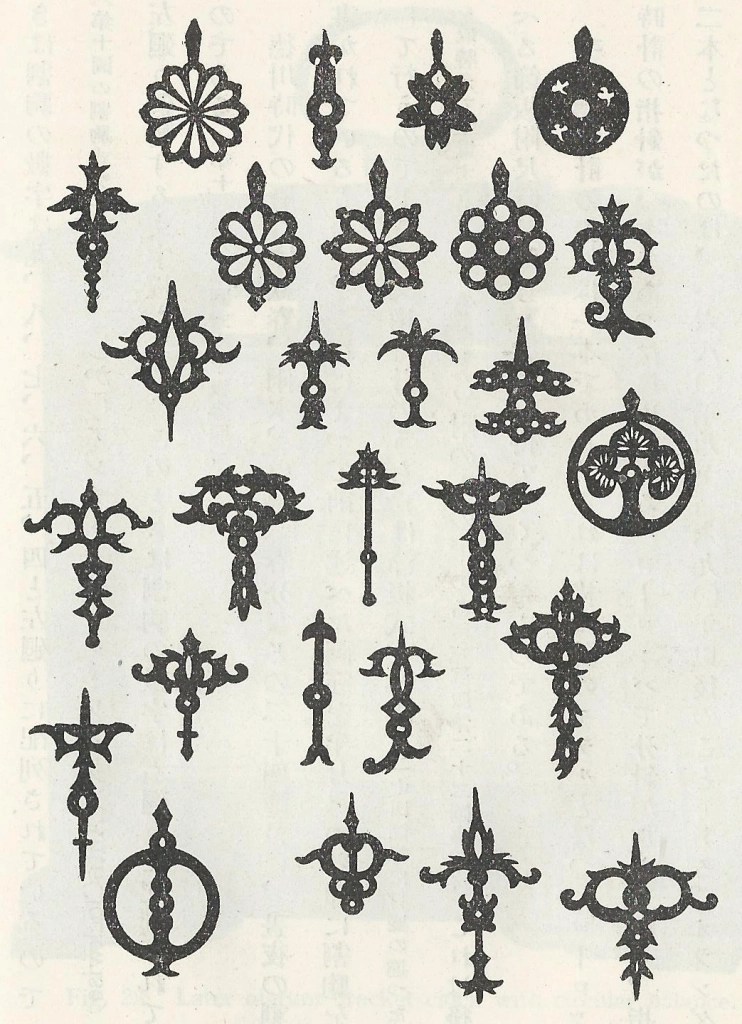
Wadokei dial hands are uniquely Japanese and demonstrate the intricate capabilities of the metalworkers in Edo Japan. There are various designs, with little indication as to dating. Virtually all Wadokei had a single Hour Hand.
Strangely, Wadokei dials could be fixed or revolving, and revolving dials could rotate clockwise or anti-clockwise. However Wadokei with alarms required a revolving dial to enable the release of the alarm crankarm by the central release pin. Accordingly, Dial Hands could be fixed or revolving. Styles of Dial Hands provide little indication to the dating of Wadokei as all variants were used during the mid to late periods of Wadokei.
There were no divisions of the hours into minutes. On some Shaku-dokei a “seconds” type hand was occasionally attached to the escape wheel as a going indicator. The circle was divided corresponding to the teeth of the escape wheel but had no meaning. There was no need for a minute hand as timekeeping was not accurate (similar to pre-1750 European clocks). In some instances the spaces between the hours were divided into four or eight equal parts.
I have come across one Dai-dokei, remaining to this day in the John Drummond Robertson family that has a centre sweep “seconds hand”. It was Robertson’s most treasured wadokei – see under ‘UK Past and Present Wadokei Collections’.
Typical Hand Designs

 Sharing My Passion for Wadokei - Home Page