John Drummond Robertson’s Dai-dokei on Porcelain Stand
In John Drummond Robertson’s book “The Evolution of Clockwork – with a section on The Clocks of Japan”, 1931, he describes one of his Wadokei as “The most striking specimen in my collection of the latest period is shown in Fig.18. Here the stand and the hood are of blue and white porcelain. All four sides of the clock are of beautiful pierced and engraved fretwork. The dial is gilt. It has a circular balance. Height overall, 28 inches.”
The British Museum, London, now has 68 of Drummond Robertson’s Wadokei, whilst 64 are illustrated in his book. However, his “most striking specimen” has been “lost” for 92 years since it was illustrated in his book. In late 2022, l was approached by Drummond Robertson’s great-grandaughter to advise that the Wadokei remains in the family, and that it was only 34 miles from my home ~ and 0.3 miles from my office for 15 years !!
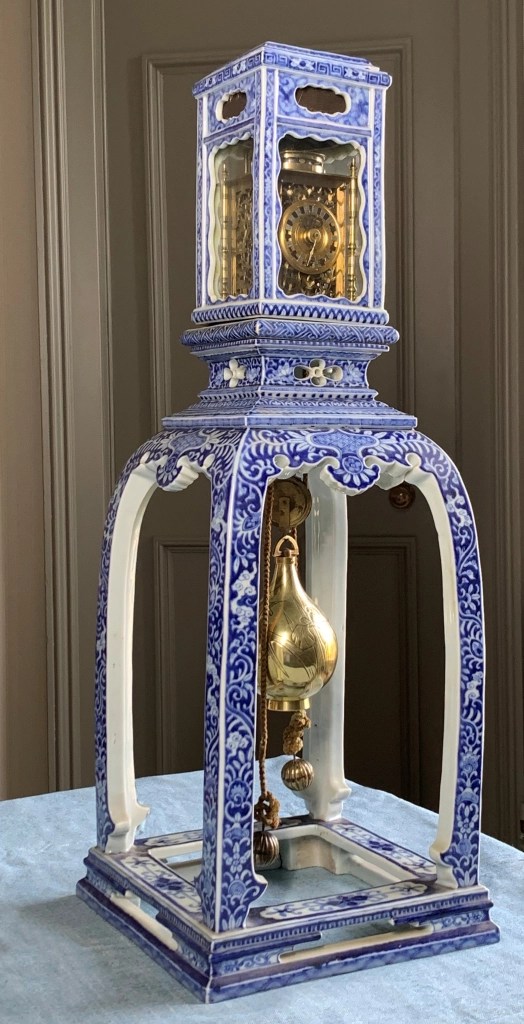
In addition to the features mentioned above, the Wadokei has:
- A centre sweep going indicator hand
- Japanese hour and half-hour striking
- Straight sided steel bell
- Dated to circa 1860
The Wadokei had almost certainly not operated for at least 100 years. However after four on-site visits undertaking stripping, cleaning and lubricating, plus several minor repairs, the Wadokei is now fully functioning. The minor repairs were (1) fitting a missing balance spring, (2) fitting a missing going / strike weight, and (3) refurbishing the centre-sweep going indicator.
No maker’s marks have been found for the Wadokei or the porcelain stand. Research has identified that Drummond Robertson bought the Wadokei from Matthieu Planchon in Paris, May 1920, along with 20 other Wadokei. Further that Planchon had owned it from at least 1896.
 Sharing My Passion for Wadokei - Home Page