During the Late Wadokei period several European Pocket Watches (mainly London made) were gifted as part of English and Dutch trading. Whilst many were adapted to Inro-dokei (see separate webpage) some retained their original European cases. These were adapted by the Japanese jimi-sho to incorporate one day dials (24 hour), namagata dial chapter rings and Japanese style hands.
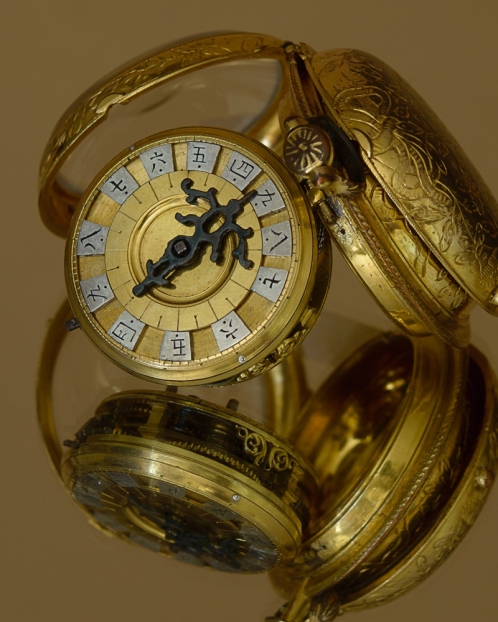
Example (right): From my collection, this particular movement was made by Jos’h (Joseph) Hardin, London, circa 1750. Gilt verge movement, chain and fusee, decoratively pierced balance cock, flat hair spring, steel balance wheel, silver-regulator disk. Joseph Hardin (or Harding) is recorded as starting his apprenticeship in 1734, becoming free of the Clockmakers’ Company (Guild) 1744 and dying 1778. He is recorded working in London at St John’s Street, 1745; St John’s Lane, 1752; Old Jewry, 1768 to 1775.
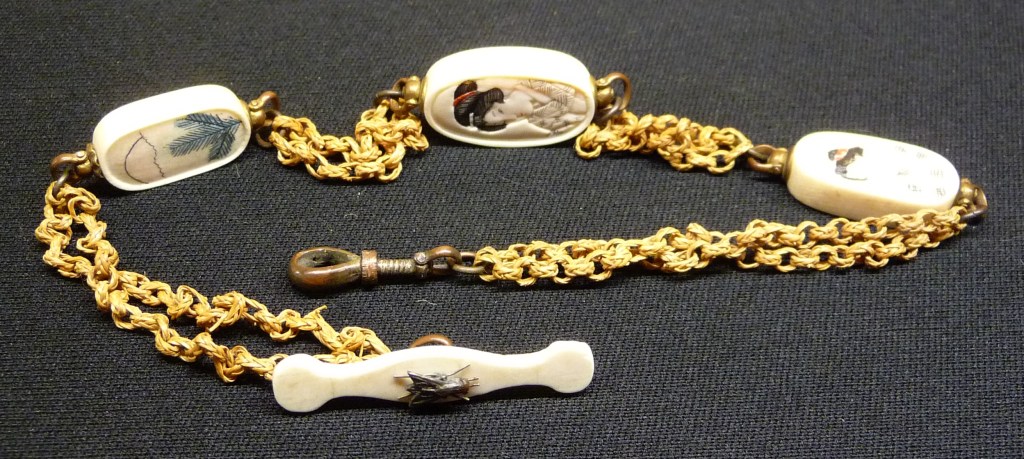
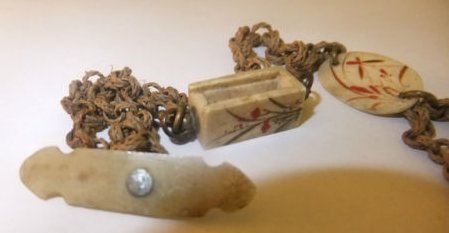
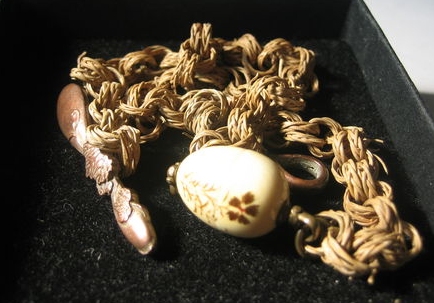
The introduction of the European pocket watch to Japan also brought with it the introduction of pocket watch chains. Whilst European chains were predominantly made of silver or gold, the Japanese used their own special artistic skills in ivory, bone and bamboo – see examples from my collection (below).
Japanese Pocket Watch Chains
 Sharing My Passion for Wadokei - Home Page