Spring- Driven Table Wadokei
Generic Description:
Period: Middle to Late Period from 1750.
Escapement: Crownwheel and verge with single foliot on early examples and balance wheel on later examples.
Power Source: Mainspring.
Construction: Lantern style in iron and brass with foliot on early examples. Later examples made entirely of brass between a pair of front and back plates with additional decorative front plate. Used the fusee system for adjusting the strength of the mainspring in order to increase accuracy. Makura-dokei are separately enclosed in glazed wooden cases. Usually have ‘waricoma’ dial with movable hour markers around the chapter ring.
Makura-dokei derived their name from the fact that they resembled ornate wooden head pillows, called Makura, used by geisha.
They are considered to be the most beautiful of Japanese clocks ever made. However, they did not provide accurate time due to the fact that there was only an hour hand and they had movable hour markers on a very small dial.

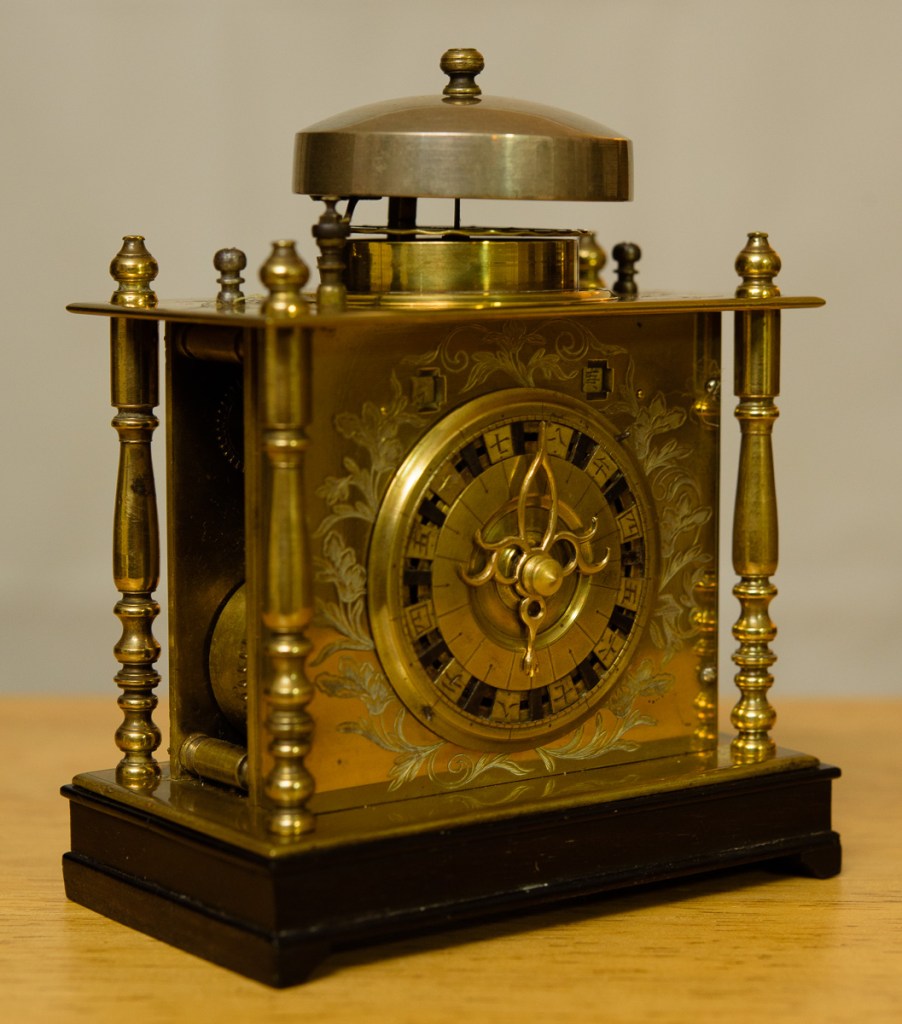
Background to the above Wadokei
Purchased at Gardiner Houlgate Auction, Bath, England, 2013. Previously, in 2005, it was part of the Albert Odmark collection sold at Christie’s San Francisco, and prior to that Mrs Takahashi, California.
Date: Estimated to be mid-1800’s from its construction and bell shape, mechanism, plus shallow bell design (considered original as it aligns with alarm hammer and foliots).
Restoration of the above Wadokei
No restoration to the clock undertaken. Minor cosmetic cleaning.
Case lining replaced with correct leno-weave silk cloth, replacing flock cloth.
 Sharing My Passion for Wadokei - Home Page