Traditional Wadokei Dial
Wadokei dials divided the day into 12 hours based on the principles of Buddha (563 BC – 483 BC) that came to Japan from India via China (see Overview / Timekeeping in Edo Period). Early dials indicated the Buddhist Animals only. Mid period dials also included the number of bell strikes for the hour (9-4), whilst the later period dials having 8 or 10 sub-divisions of the hour.
Note: With early Wadokei the dial was stationary and the hand revolved, whilst for the majority of later Wadokei the dial rotated and the hand was fixed in the vertical position.
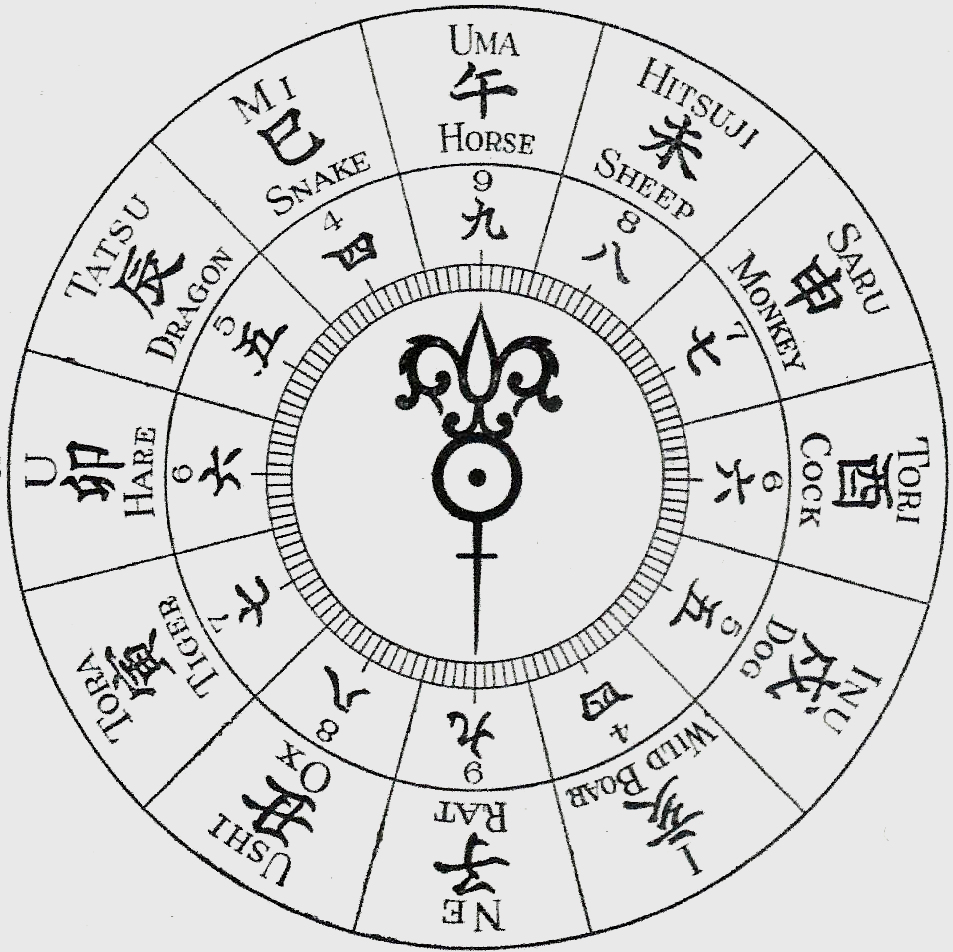
All Wadokei Dials indicated Temporal Time
For all Wadokei the important “hours” are the Hare Hour kure–mutsu (brightening 6) at Dawn, and the Cock Hour ake-mutsu (darkening 6) at Dusk. The period of time between kure-mutsu and ake mutsu varied with the Seasons.

Waricoma Dials
Warikoma dials were introduced in the late-1700’s and facilitated moving the position of the hour markers to suit Temporal Time. Whilst the hand and dial rotated constantly throughout the day, the kure-matsu and ake-matsu could be repositioned according to the seasons. The introduction of the Waricoma dial made the double foliot unnecessary and provided a simpler solution to Temporal Time adjustment. The figure on the left shows the numerals set for a period during which the hours of night and day are equal. Depending on Wadokei overall design, not only could Waricoma dials be stationary or rotational, but each could rotate relatively clockwise or anti-clockwise !!
Traditional Shaku-dokei Dial
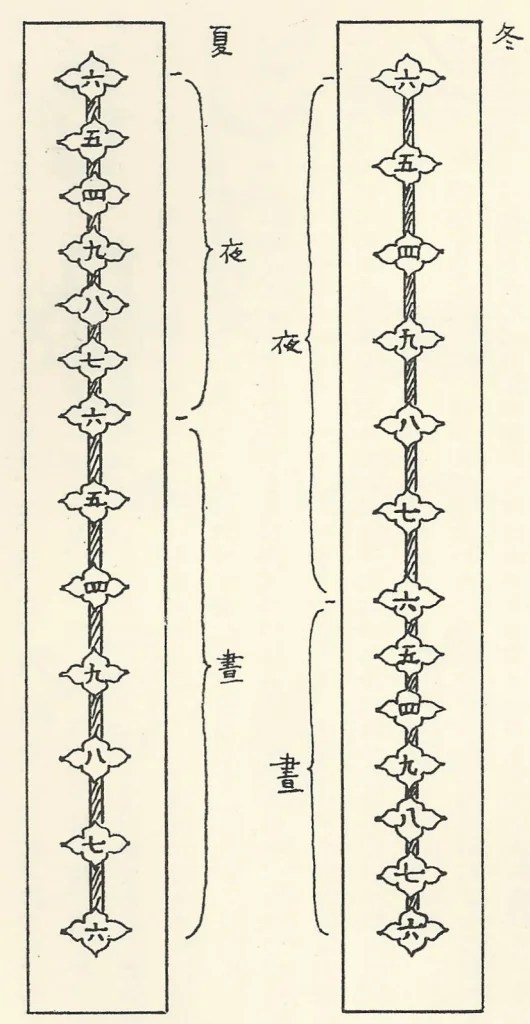
Shaku-dokei dials are a unique Japanese invention which simply told time on a linear scale corresponding to the fall of the Going Weight over a day.
Many versions were developed of this type of Wadokei, which were made throughout the Tokugawa period. However, the traditional and most basic design has a groove running down the centre of the lower trunk with adjustable “hour” markers that, in all but early models, also had plain half-hour markers. Alongside these hour markers was a second groove down which a pointer attached to the Going Weight descended. Thus as the weight falls the hours are indicated in succession.
 Sharing My Passion for Wadokei - Home Page